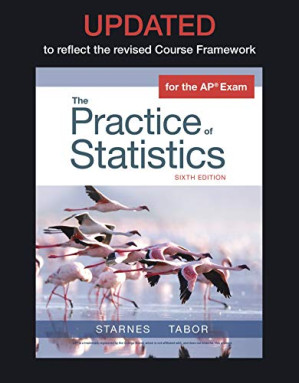
The Practice of Statistics 6th Edition (Updated) 🔍
Daren S. Starnes, Josh Tabor
W. H. Freeman, Dec 16, 2019
English [en] · PDF · 344.1MB · 2019 · 📘 Book (non-fiction) · 🚀/lgli/lgrs/nexusstc/zlib · Save
description
The Practice of Statistics is the most trusted program for AP® Statistics because it provides teachers and students with everything they need to be successful in the statistics course and on the AP® Exam. With the expert authorship of high school AP® Statistics veterans, Daren Starnes and Josh Tabor and their supporting team of AP® teacher/leaders, The UPDATED Practice of Statistics , Sixth edition features a revised organization to match the new unit structure in the 2019-2020 Course Framework for AP® Statistic perfectly.
While developing this updated edition, the authors ensured that every College Board Learning Objective and Essential Knowledge statement in the 2019-2020 Course Framework is addressed fully. In addition, all of the required skills -- selecting statistical methods, data analysis, using probability and simulation, and statistical argumentation -- are integrated in the student edition and are clearly identified in the Updated Teacher’s Edition to help teachers reinforce them at point of use.
The Updated Practice of Statistics program combines a data analysis approach with the power of technology, innovative pedagogy, and an extensive support program entirely refreshed to reflect the changes that will allow teachers to use the revised College Board organization and content seamlessly. The Updated edition features an extensive set of resources including a robust online homework program, the extensively revised Test Bank, a comprehensive set of videos, and the Teacher’s Edition and Teacher’s Resource Materials, giving teachers and students everything they need to realize success on the exam and in the course.
While developing this updated edition, the authors ensured that every College Board Learning Objective and Essential Knowledge statement in the 2019-2020 Course Framework is addressed fully. In addition, all of the required skills -- selecting statistical methods, data analysis, using probability and simulation, and statistical argumentation -- are integrated in the student edition and are clearly identified in the Updated Teacher’s Edition to help teachers reinforce them at point of use.
The Updated Practice of Statistics program combines a data analysis approach with the power of technology, innovative pedagogy, and an extensive support program entirely refreshed to reflect the changes that will allow teachers to use the revised College Board organization and content seamlessly. The Updated edition features an extensive set of resources including a robust online homework program, the extensively revised Test Bank, a comprehensive set of videos, and the Teacher’s Edition and Teacher’s Resource Materials, giving teachers and students everything they need to realize success on the exam and in the course.
Alternative filename
lgli/Textbook - The Practice of Statistics.pdf
Alternative filename
lgrsnf/Textbook - The Practice of Statistics.pdf
Alternative title
Updated Version of The Practice of Statistics for the APA Course (Student Edition)
Alternative author
Starnes, Daren S., Tabor, Josh
Alternative publisher
Macmillan Learning
Alternative publisher
Springer Nature
Alternative edition
Place of publication not identified, 2019
Alternative edition
United States, United States of America
Alternative edition
Sixth, PS, 2019
metadata comments
The second part has been scanned from phone. It isn't the best quality but it should do for now!
metadata comments
{"edition":"6","isbns":["131926929X","9781319269296"],"last_page":1024,"publisher":"W. H. Freeman"}
Alternative description
Front Matter
Cover Page
Title Page
Copyright Page
Contents
About the Authors
Content Advisory Board and Supplements Team
Acknowledgments
To the Student
Overview: What Is Statistics?
UNIT 1 Exploring One-Variable Data
Chapter 1 Data Analysis
Introduction Statistics: The Science and Art of Data
Organizing Data
From Data Analysis to Inference
1.1 Analyzing Categorical Data
Displaying Categorical Data: Bar Graphs and Pie Charts
Graphs: Good and Bad
Analyzing Data on Two Categorical Variables
1.2 Displaying Quantitative Data with Graphs
Dotplots
Describing Shape
Describing Distributions
Comparing Distributions
Stemplots
Histograms
Using Histograms Wisely
1.3 Describing Quantitative Data with Numbers
Measuring Center: The Mean
Measuring Center: The Median
Comparing the Mean and the Median
Measuring Variability: The Range
Measuring Variability: The Standard Deviation
Measuring Variability: The Interquartile Range (IQR)
Numerical Summaries with Technology
Identifying Outliers
Making and Interpreting Boxplots
Comparing Distributions with Boxplots
Chapter 1 Wrap-Up
Free Response AP® Problem, Yay!
Chapter 1 Review
Chapter 1 Review Exercises
Chapter 1 AP® Statistics Practice Test
Chapter 1 Project American Community Survey
Chapter 2 Modeling Distributions of Quantitative Data
Introduction
2.1 Describing Location in a Distribution
Measuring Location: Percentiles
Cumulative Relative Frequency Graphs
Measuring Location: Standardized Scores
Transforming Data
2.2 Density Curves and Normal Distributions
Density Curves
Describing Density Curves
Normal Distributions
The Empirical Rule
Finding Areas in a Normal Distribution
Working Backward: Finding Values from Areas
Assessing Normality
Chapter 2 Wrap-Up
Free Response AP® Problem, Yay!
Chapter 2 Review
Chapter 2 Review Exercises
Chapter 2 AP® Statistics Practice Test
UNIT 2 Exploring Two-Variable Data
Chapter 3 Exploring Two-Variable Quantitative Data
Introduction
3.1 Scatterplots and Correlation
Explanatory and Response Variables
Displaying Relationships: Scatterplots
Describing a Scatterplot
Measuring Linear Association: Correlation
Cautions about Correlation
Calculating Correlation
Additional Facts about Correlation
3.2 Least-Squares Regression
Prediction
Residuals
Interpreting a Regression Line
The Least-Squares Regression Line
Determining if a Linear Model Is Appropriate: Residual Plots
How Well the Line Fits the Data: The Role of s and r2 in Regression
Interpreting Computer Regression Output
Regression to the Mean
Correlation and Regression Wisdom
3.3 Transforming to Achieve Linearity
Transforming with Powers and Roots
Transforming with Logarithms: Power Models
Transforming with Logarithms: Exponential Models
Putting It All Together: Which Transformation Should We Choose?
Chapter 3 Wrap-Up
Free Response AP® Problem, Yay!
Chapter 3 Review
Chapter 3 Review Exercises
Chapter 3 AP® Statistics Practice Test
Chapter 3 Project
UNIT 3 Collecting Data
Chapter 4 Collecting Data
Introduction
4.1 Sampling and Surveys
The Idea of a Sample Survey
How to Sample Badly
How to Sample Well: Random Sampling
Other Random Sampling Methods
Sample Surveys: What Else Can Go Wrong?
4.2 Experiments
Observational Studies Versus Experiments
The Language of Experiments
Designing Experiments: Comparison
Designing Experiments: Blinding and the Placebo Effect
Designing Experiments: Random Assignment
Designing Experiments: Control
Designing Experiments: Replication
Experiments: Putting It All Together
Completely Randomized Designs
Randomized Block Designs
4.3 Using Studies Wisely
Inference for Sampling
Inference for Experiments
The Scope of Inference: Putting it All Together
The Challenges of Establishing Causation
Data Ethics
Chapter 4 Wrap-Up
Free Response AP® Problem, Yay!
Chapter 4 Review
Chapter 4 Review Exercises
Chapter 4 AP® Statistics Practice Test
Chapter 4 Project Response Bias
Cumulative AP® Practice Test 1
UNIT 4 Probability, Random Variables, and Probability Distributions
Chapter 5 Probability: What Are the Chances?
Introduction
5.1 Randomness, Probability, and Simulation
The Idea of Probability
Simulation
5.2 Probability Rules
Probability Models
Basic Probability Rules
Two-Way Tables, Probability, and the General Addition Rule
Venn Diagrams and Probability
5.3 Conditional Probability and Independence
What Is Conditional Probability?
Conditional Probability and Independence
The General Multiplication Rule
Tree Diagrams and Conditional Probability
The Multiplication Rule for Independent Events
Chapter 5 Wrap-Up
Free Response AP® Problem, Yay!
Chapter 5 Review
Chapter 5 Review Exercises
Chapter 5 AP® Statistics Practice Test
UNIT 4 Probability, Random Variables, and Probability Distributions
Chapter 6 Random Variables and Probability Distributions
Introduction
6.1 Discrete and Continuous Random Variables
6.2 Transforming and Combining Random Variables
6.3 Binomial and Geometric Random Variables
Chapter 6 Wrap-Up
Frappy! Free Response AP® Problem, Yay!
Chapter 6 Review
Chapter 6 Review Exercises
Chapter 6 AP® Statistics Practice Test
Back Matter
Formulas for the AP® Statistics Exam
Solutions
Tables
Table A Standard Normal probabilities
Table B t distribution critical values
Table C Chi-square distribution critical values
Table D Random digits
Technology Corner References
AP® Statistics Course Skills Alignment to UPDATED The Practice of Statistics, 6th edition
UNIT 5 Sampling Distributions
Chapter 7 Sampling Distributions
UNIT 6 Inference for Categorical Data: Proportions
Chapter 8 Estimating Proportions with Confidence
Chapter 9 Testing Claims About Proportions
UNIT 7 Inference for Quantitative Data: Means
Chapter 10 Estimating Means with Confidence
Chapter 11 Testing Claims About Means
UNIT 8 Inference for Categorical Data: Chi-Square
UNIT 9 Inference for Quantitative Data: Slopes
Chapter 12 Inference for Distributions and Relationships
About the AP Exam and AP Exam Tips
Solutions
Cover Page
Title Page
Copyright Page
Contents
About the Authors
Content Advisory Board and Supplements Team
Acknowledgments
To the Student
Overview: What Is Statistics?
UNIT 1 Exploring One-Variable Data
Chapter 1 Data Analysis
Introduction Statistics: The Science and Art of Data
Organizing Data
From Data Analysis to Inference
1.1 Analyzing Categorical Data
Displaying Categorical Data: Bar Graphs and Pie Charts
Graphs: Good and Bad
Analyzing Data on Two Categorical Variables
1.2 Displaying Quantitative Data with Graphs
Dotplots
Describing Shape
Describing Distributions
Comparing Distributions
Stemplots
Histograms
Using Histograms Wisely
1.3 Describing Quantitative Data with Numbers
Measuring Center: The Mean
Measuring Center: The Median
Comparing the Mean and the Median
Measuring Variability: The Range
Measuring Variability: The Standard Deviation
Measuring Variability: The Interquartile Range (IQR)
Numerical Summaries with Technology
Identifying Outliers
Making and Interpreting Boxplots
Comparing Distributions with Boxplots
Chapter 1 Wrap-Up
Free Response AP® Problem, Yay!
Chapter 1 Review
Chapter 1 Review Exercises
Chapter 1 AP® Statistics Practice Test
Chapter 1 Project American Community Survey
Chapter 2 Modeling Distributions of Quantitative Data
Introduction
2.1 Describing Location in a Distribution
Measuring Location: Percentiles
Cumulative Relative Frequency Graphs
Measuring Location: Standardized Scores
Transforming Data
2.2 Density Curves and Normal Distributions
Density Curves
Describing Density Curves
Normal Distributions
The Empirical Rule
Finding Areas in a Normal Distribution
Working Backward: Finding Values from Areas
Assessing Normality
Chapter 2 Wrap-Up
Free Response AP® Problem, Yay!
Chapter 2 Review
Chapter 2 Review Exercises
Chapter 2 AP® Statistics Practice Test
UNIT 2 Exploring Two-Variable Data
Chapter 3 Exploring Two-Variable Quantitative Data
Introduction
3.1 Scatterplots and Correlation
Explanatory and Response Variables
Displaying Relationships: Scatterplots
Describing a Scatterplot
Measuring Linear Association: Correlation
Cautions about Correlation
Calculating Correlation
Additional Facts about Correlation
3.2 Least-Squares Regression
Prediction
Residuals
Interpreting a Regression Line
The Least-Squares Regression Line
Determining if a Linear Model Is Appropriate: Residual Plots
How Well the Line Fits the Data: The Role of s and r2 in Regression
Interpreting Computer Regression Output
Regression to the Mean
Correlation and Regression Wisdom
3.3 Transforming to Achieve Linearity
Transforming with Powers and Roots
Transforming with Logarithms: Power Models
Transforming with Logarithms: Exponential Models
Putting It All Together: Which Transformation Should We Choose?
Chapter 3 Wrap-Up
Free Response AP® Problem, Yay!
Chapter 3 Review
Chapter 3 Review Exercises
Chapter 3 AP® Statistics Practice Test
Chapter 3 Project
UNIT 3 Collecting Data
Chapter 4 Collecting Data
Introduction
4.1 Sampling and Surveys
The Idea of a Sample Survey
How to Sample Badly
How to Sample Well: Random Sampling
Other Random Sampling Methods
Sample Surveys: What Else Can Go Wrong?
4.2 Experiments
Observational Studies Versus Experiments
The Language of Experiments
Designing Experiments: Comparison
Designing Experiments: Blinding and the Placebo Effect
Designing Experiments: Random Assignment
Designing Experiments: Control
Designing Experiments: Replication
Experiments: Putting It All Together
Completely Randomized Designs
Randomized Block Designs
4.3 Using Studies Wisely
Inference for Sampling
Inference for Experiments
The Scope of Inference: Putting it All Together
The Challenges of Establishing Causation
Data Ethics
Chapter 4 Wrap-Up
Free Response AP® Problem, Yay!
Chapter 4 Review
Chapter 4 Review Exercises
Chapter 4 AP® Statistics Practice Test
Chapter 4 Project Response Bias
Cumulative AP® Practice Test 1
UNIT 4 Probability, Random Variables, and Probability Distributions
Chapter 5 Probability: What Are the Chances?
Introduction
5.1 Randomness, Probability, and Simulation
The Idea of Probability
Simulation
5.2 Probability Rules
Probability Models
Basic Probability Rules
Two-Way Tables, Probability, and the General Addition Rule
Venn Diagrams and Probability
5.3 Conditional Probability and Independence
What Is Conditional Probability?
Conditional Probability and Independence
The General Multiplication Rule
Tree Diagrams and Conditional Probability
The Multiplication Rule for Independent Events
Chapter 5 Wrap-Up
Free Response AP® Problem, Yay!
Chapter 5 Review
Chapter 5 Review Exercises
Chapter 5 AP® Statistics Practice Test
UNIT 4 Probability, Random Variables, and Probability Distributions
Chapter 6 Random Variables and Probability Distributions
Introduction
6.1 Discrete and Continuous Random Variables
6.2 Transforming and Combining Random Variables
6.3 Binomial and Geometric Random Variables
Chapter 6 Wrap-Up
Frappy! Free Response AP® Problem, Yay!
Chapter 6 Review
Chapter 6 Review Exercises
Chapter 6 AP® Statistics Practice Test
Back Matter
Formulas for the AP® Statistics Exam
Solutions
Tables
Table A Standard Normal probabilities
Table B t distribution critical values
Table C Chi-square distribution critical values
Table D Random digits
Technology Corner References
AP® Statistics Course Skills Alignment to UPDATED The Practice of Statistics, 6th edition
UNIT 5 Sampling Distributions
Chapter 7 Sampling Distributions
UNIT 6 Inference for Categorical Data: Proportions
Chapter 8 Estimating Proportions with Confidence
Chapter 9 Testing Claims About Proportions
UNIT 7 Inference for Quantitative Data: Means
Chapter 10 Estimating Means with Confidence
Chapter 11 Testing Claims About Means
UNIT 8 Inference for Categorical Data: Chi-Square
UNIT 9 Inference for Quantitative Data: Slopes
Chapter 12 Inference for Distributions and Relationships
About the AP Exam and AP Exam Tips
Solutions
date open sourced
2022-04-15
🚀 Fast downloads
Become a member to support the long-term preservation of books, papers, and more. To show our gratitude for your support, you get fast downloads. ❤️
- Fast Partner Server #1 (recommended)
- Fast Partner Server #2 (recommended)
- Fast Partner Server #3 (recommended)
- Fast Partner Server #4 (recommended)
- Fast Partner Server #5 (recommended)
- Fast Partner Server #6 (recommended)
- Fast Partner Server #7
- Fast Partner Server #8
- Fast Partner Server #9
- Fast Partner Server #10
🐢 Slow downloads
From trusted partners. More information in the FAQ. (might require browser verification — unlimited downloads!)
- Slow Partner Server #1 (slightly faster but with waitlist)
- Slow Partner Server #2 (slightly faster but with waitlist)
- Slow Partner Server #3 (slightly faster but with waitlist)
- Slow Partner Server #4 (slightly faster but with waitlist)
- Slow Partner Server #5 (no waitlist, but can be very slow)
- Slow Partner Server #6 (no waitlist, but can be very slow)
- Slow Partner Server #7 (no waitlist, but can be very slow)
- Slow Partner Server #8 (no waitlist, but can be very slow)
- Slow Partner Server #9 (no waitlist, but can be very slow)
- After downloading: Open in our viewer
All download options have the same file, and should be safe to use. That said, always be cautious when downloading files from the internet, especially from sites external to Anna’s Archive. For example, be sure to keep your devices updated.
External downloads
-
For large files, we recommend using a download manager to prevent interruptions.
Recommended download managers: JDownloader -
You will need an ebook or PDF reader to open the file, depending on the file format.
Recommended ebook readers: Anna’s Archive online viewer, ReadEra, and Calibre -
Use online tools to convert between formats.
Recommended conversion tools: CloudConvert and PrintFriendly -
You can send both PDF and EPUB files to your Kindle or Kobo eReader.
Recommended tools: Amazon‘s “Send to Kindle” and djazz‘s “Send to Kobo/Kindle” -
Support authors and libraries
✍️ If you like this and can afford it, consider buying the original, or supporting the authors directly.
📚 If this is available at your local library, consider borrowing it for free there.
Total downloads:
A “file MD5” is a hash that gets computed from the file contents, and is reasonably unique based on that content. All shadow libraries that we have indexed on here primarily use MD5s to identify files.
A file might appear in multiple shadow libraries. For information about the various datasets that we have compiled, see the Datasets page.
For information about this particular file, check out its JSON file. Live/debug JSON version. Live/debug page.